Industry
Part of Judging a book nook kit by fit, upkeep and the supplied LED
What a trustworthy book nook kit maker actually publishes
A trustworthy book nook kit maker publishes original designs with clear instructions, genuine wood and fabric materials, and honest photos before you buy.
What to take away
- A trustworthy book nook kit maker publishes a parts list, finished outside dimensions, sheet thickness, light spec and a spare-parts route.
- Named makers worth checkingRolife, CuteBee, Hands Craft, Aslope and Book Nook Kit Studio.
- The five checks in this piece are the pass/fail test. Fail three of the five and skip the listing.
- A kit sold to adults is not a children's product, so a choking warning on the box tells you less than buyers assume.
- Most kits are designed by one party, cut by another and sold under a third name.
- If a kit turns out to be unsafe, reporting it to CPSC is free and can be done online.
Makers worth finding: Rolife, CuteBee, Hands Craft, Aslope and Book Nook Kit Studio
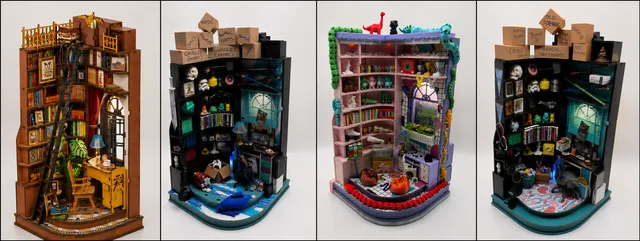
Rolife, sold through Robotime, is the volume name in this trade. Its kits are laser-cut plywood and paper, mostly 1:24, with printed instructions and a published parts list. It suits a first build.
Rolife also sells spare sheets and figures through its own store, which most makers do not offer. As of 2026, typical Rolife 1:24 kits list from about $35 to $80.
CuteBee sells book nooks and room boxes in the same plywood-and-paper idiom. Its kits often cost less than Rolife and include LED strips. Its listings tend to show the finished piece and the box, and less of the sheet.
Ask for the sheet photo before you buy. As of 2026, typical CuteBee kits list from about $25 to $55.
Hands Craft distributes Rolife and its own line into North America. The same kit can appear under both names. Buying from the distributor shortens the replacement-parts path. As of 2026, typical Hands Craft listings run from about $30 to $70.
Aslope and Book Nook Kit Studio sit in the small-shop tier. Both publish finished dimensions and light type on the listing. That is what you want to see from a maker with no brand recognition to lean on. As of 2026, small-shop book nook kits often list from about $50 to $120, depending on size and lighting.
None of these are ranked. What follows is the test to run on any of them.
What a good kit maker publishes
- A parts list with quantities, so a missing sheet is provable.
- Outside dimensions of the finished piece, not the box.
- Sheet material and thickness, in millimeters.
- Light type, color temperature and how the battery compartment opens.
- A way to buy one replacement sheet.
A maker that publishes none of that is not necessarily bad. It is simply not giving you a way to check anything before the parcel arrives.
A published spec block is what makes the checklist testable. Rolife's own store listings carry one, though field names vary between kits. It typically gives finished size, scale, wood sheet count, assembly time, recommended age (14 plus) and battery type.
What a Good Kit Maker Publishes
- Parts list with quantities
- Outside dimensions of finished piece
- Sheet material and thickness in mm
- Light type, color temperature, battery access
- A way to buy one replacement sheet
Rolife and Hands Craft publish parts lists. Aslope and Book Nook Kit Studio publish finished dimensions and light type on the listing. CuteBee often leaves the sheet unshown, so ask for it.
How a kit reaches a shelf
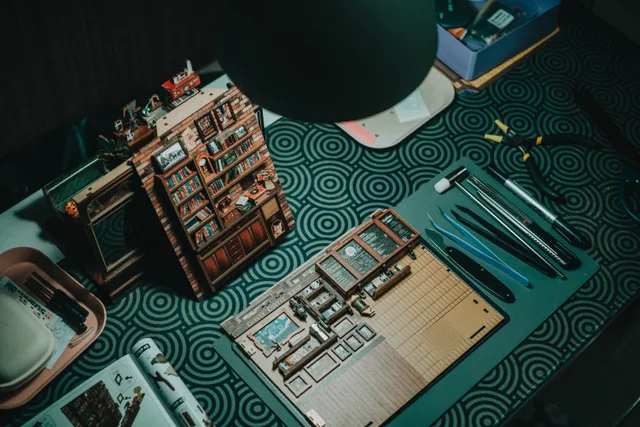
Three roles usually sit behind a boxed kit, and they are often three companies. One designs the scene and the cut file. One runs the laser and packs the box. One markets and sells it, sometimes under a storefront name that exists nowhere else.
That structure explains most of what buyers find confusing. Identical kits appear under several names. Instructions are translated once and never revised. Replacement parts are unavailable because the seller never held stock. A good design can arrive cut badly, and a mediocre design cut well.
What the warnings mean
The small parts warning is not boilerplate. CPSC's guidance on the small parts ban and choking hazard labeling puts the ban at 16 CFR part 1501, and it applies to children's products intended for children under three. The labeling rule sits at 16 CFR 1500.19.
A warning therefore tells you the seller places the product inside that regime. Its absence tells you less than people assume, because a kit sold to adults is not a children's product at all.
A worked example: reading one listing
Take a typical 1:24 kit listing that shows a lit room and a price.
Here is that listing, described field by field as such listings appear.
- TitleDIY Miniature Book Nook Kit, 1:24 scale, with LED.
- Photographsthe finished room lit, the box, and one shot of the assembled shelves.
- Spec blockfinished size, 1:24 scale, assembly time, recommended age 14 plus.
- Priceinside the $35 to $80 band typical for a 1:24 kit as of 2026.
- Not shownsheet count, sheet thickness in millimeters, battery size, spare-sheet route.
Score that listing against the five checks.
Reading one listing
| Check | In this listing |
|---|---|
| Parts list with quantities | No |
| Outside dimensions of the finished piece | Yes |
| Sheet material and thickness in millimeters | No |
| Light type, color temperature, battery compartment | No |
| Way to buy one replacement sheet | No |
One check passes. Four fail. The missing sheet photo is the one to ask the seller for first, because thickness and cut quality decide how the build goes.
Five Checks on One Listing
- Find the finished size, not box size
- Find sheet thickness, under 2 mm warps
- Find light2700-3000 K warm white
- Find the spare-parts route
- Check the age statement, 14 plus
Any listing that fails three of those five is a listing to skip, whatever the photographs look like.
If something turns out to be unsafe
There is a federal route, and it costs nothing. CPSC's public incident reporting service takes consumer reports online. A report tells other buyers about a dangerous product and helps the Commission decide whether to act, by recall, fine or regulation.
Personal information stays confidential, and your name and contact details are not released. Reports can also be made by phone or by emailing the downloadable form.
For classes and studios, see finding classes and studios, and for judging a kit in your hands, see judging a kit on value and fit. What to buy before the first build is in the first-purchase guide.
Common questions
Why do the same kits appear under different brands?
Because design, manufacture and retail are usually separate companies. The storefront name is often the last link in that chain and the one with no stock.
Are instructions always this thin?
Frequently. Treat the plan as a parts diagram and work out the build sequence yourself, dry-fitting each subassembly before glue.
Can I sell a build made from someone else's kit?
Read what you agreed to at purchase, and ask the seller. That is a licensing question, not a craft one, and the answer varies by maker.
Is a more expensive kit better cut?
Often, though not reliably. Sheet thickness and cut quality show in photographs if you look at the edges rather than the finished room.