Costs
Part of Judging a book nook kit by fit, upkeep and the supplied LED
Pricing Formulas for Book Nook Builds
Reusable pricing formulas for book nook builds, a general business example, and payment-method considerations—not estimates of what book nook kits cost.
What pricing formulas can tell you about book nook kits
- The box price is only part of the cost of a first kit build. The rest is what the box leaves out.
- No miniature prices are quoted here. The formulas below come from published extension guidance.
- Pricing by multiplying material cost alone can leave labor and overhead uncovered.
- If you sell kit builds online, payment processing is a real line item, not a rounding error.
What the box price hides
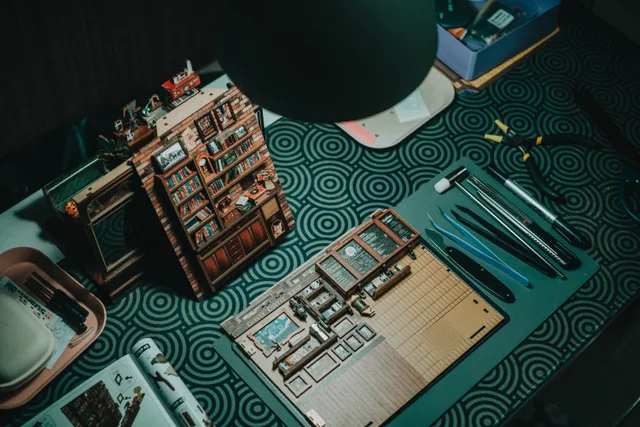
A kit's price covers cut parts, a plan and usually a cheap light. It does not cover the blade, the glue, the primer, the paints, the sanding sticks or the light you will actually keep. A first build may require buying tools and consumables beyond the kit. Tools are reused; consumables are replenished as they run out.
That is the whole point of separating one-off tooling from per-build consumables. Judge a kit against the marginal cost of building it, not against the total you spent on the first one.
Three ways people price, and what happens
University of Maine Extension's bulletin on basic pricing strategies for small businesses works one example all the way through, and it is worth borrowing because the arithmetic is the same at any scale. Its sample is five units, 30 dollars of materials, ten hours of work at a wanted rate of ten dollars an hour, and 20 dollars of overhead.
- Formula A, materials plus labor divided by units, gives 26 dollars each. The bulletin points out this leaves nothing for overhead, profit or inflation: at 26 dollars you simply break even.
- Formula B multiplies material cost by a fixed number, often three, giving 18 dollars each. The bulletin warns that the profit margin from this method is likely to be very slim or non-existent unless production is extremely efficient and materials are cheap.
- Formula C, the bulletin's individualized approach to pricing, builds the price up from all costs: cost of materials + overhead + desired weekly wage + profit, divided by the number of units. In the sample, ten hours is ¼ of the work week, so the wage is ¼ of $600 = $150 and the profit ¼ of $40 = $10. That gives $30 + $20 + $150 + $10, divided by five units: $42 per unit.
Those are that bulletin's numbers, not miniature numbers. The lesson transfers exactly: any formula keyed only to material cost ignores the hours, and hours are most of what a miniature costs.
The fees at the end
If kit builds get sold, the money does not arrive whole. Penn State Extension's overview of e-commerce payment methods describes the gateway layer between buyer and seller. It names Stripe, Square, Authorize.net, Braintree and PayPal.
Some platforms include a gateway; others let you choose. The overview warns that wanting payment methods your integrated gateway does not accept means subscribing to an add-on gateway and paying more.
It also gives an idea of what buyers expect. In a 2022 survey, the largest share of respondents used PayPal at 37 percent, followed by 15 percent using Venmo and 12 percent using other digital wallets.
The practical upshot is that offering fewer payment methods costs you sales and offering more costs you fees, and both belong in the price.
Putting it together
Price a kit build as: kit, plus consumables actually used, plus a share of tooling, plus your hours, plus fees if it sells. The first of those is the only number printed anywhere.
Written as Formula C for one book nook build, with letters for the figures you take from your own receipts and timesheet:
| Line | What goes in it | Where the figure comes from |
|---|---|---|
| K | The kit itself | The price you paid for the box |
| C | Consumables used on this build | Glue, primer, paint, blades and sanding sticks, as a share of each pack |
| T | Tooling share | Each tool's price divided by the builds you expect it to last |
| L | Replacement light, if any | The light you fitted instead of the supplied one |
| W | Your wage | Hours on this build times the hourly rate you want |
| P | Profit | The amount you decide the build should earn beyond your wage |
Price per build = K + C + T + L + W + P, then add the payment fee for the method the buyer uses. Formula A on the same build would stop at K + C + W and leave tooling, the light and profit uncovered; Formula B would multiply K + C by three and ignore your hours entirely. The general version of this arithmetic is in pricing supplies for a build, and the wider budget picture is in where the money goes.